



News
Explore what’s going on around the industry and get the latest from the world of heavy equipment and earth-moving.

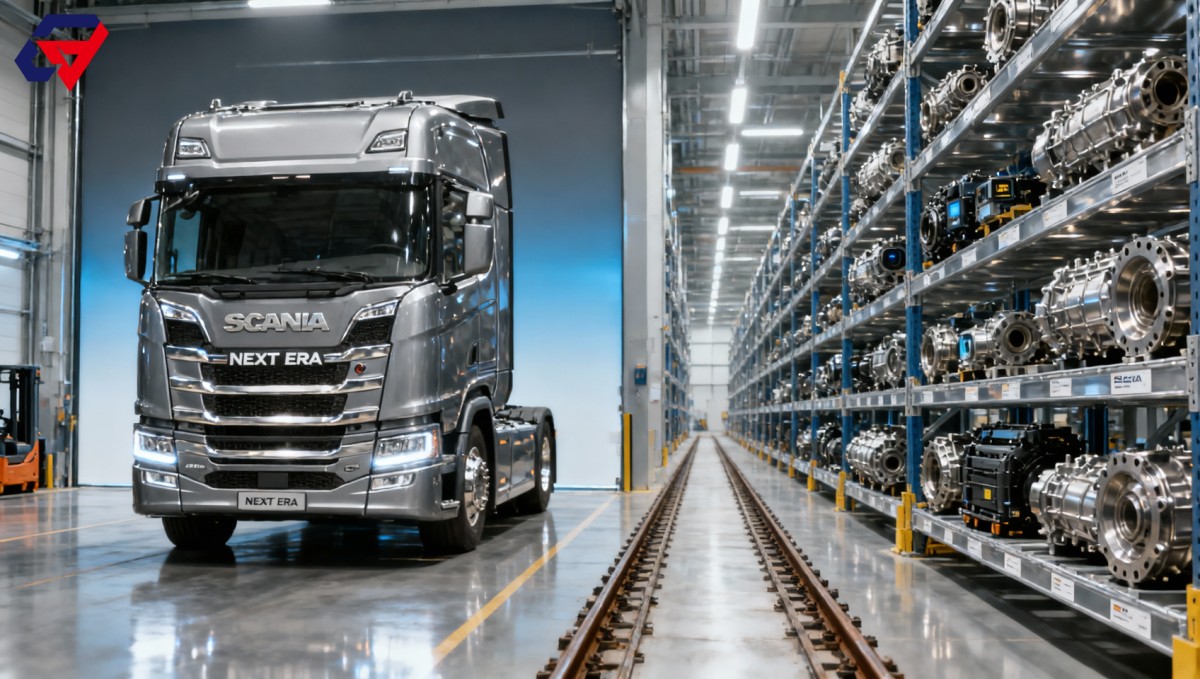
On April 22, 2026, Scania officially launched its dedicated China-based spare parts center for the NEXT ERA heavy-duty truck platform. This development is particularly relevant for international commercial vehicle operators, cross-border fleet service providers, and global aftermarket supply chain stakeholders — as it introduces a new operational benchmark for just-in-time parts availability and cross-regional service alignment.
Event Overview
On April 22, 2026, Scania activated its China spare parts center specifically supporting the NEXT ERA heavy-duty truck platform. All core components stocked at the center have undergone Scania’s global unified quality verification process. The center operates in real-time coordination with Scania’s nationwide service network in China and became operational one month prior to the scheduled bulk delivery of NEXT ERA vehicles. Its stated function is to enable original-equipment-grade spare parts to be available for overseas customers on the day of vehicle pickup, thereby reducing downtime risk and repair wait times caused by part shortages.
Industries Affected
International Commercial Vehicle Importers & Distributors
These entities are directly impacted because the parts center enables faster post-delivery service readiness for imported NEXT ERA units. Previously, extended lead times for critical spares from Europe or regional hubs could delay commissioning or increase local inventory holding costs. With localized high-reliability parts now available at time of handover, importers face revised expectations around warranty support timelines and service-level commitments to end customers.
Global Fleet Maintenance & Repair Operators (MROs)
MROs serving multinational transport companies may experience shifts in parts sourcing strategy. If Scania extends this ‘day-of-pickup’ parts guarantee to select export markets beyond China, MROs in those regions may need to align their diagnostic workflows, technician training, and parts provisioning cadence with Scania’s new logistics rhythm — especially for time-sensitive repairs involving engine, transmission, or ADAS-related modules.
Aftermarket Logistics & Distribution Providers
Third-party logistics firms handling Scania parts distribution — particularly those managing bonded warehousing, customs clearance, or last-mile delivery for heavy-duty vehicle networks — may see adjustments in order frequency, batch sizing, and geographic allocation priorities. The center’s real-time synchronization with national service points implies tighter integration requirements with Scania’s digital service platforms, potentially affecting API access, data sharing protocols, or SLA definitions.
What Relevant Enterprises or Practitioners Should Monitor and Act On
Track official scope expansion announcements
Current information confirms the center serves NEXT ERA vehicles and supports overseas customers picking up units in China. Practitioners should monitor Scania’s official communications for clarification on whether this ‘same-day parts availability’ model will extend to other markets (e.g., Southeast Asia, Middle East) or apply to non-NEXT ERA Scania models — as such expansions would materially affect procurement planning and regional hub investments.
Verify which parts categories are covered under the ‘immediate availability’ guarantee
The announcement states that ‘core components’ are included and have passed global quality verification. However, the specific part numbers, SKUs, or subsystem families (e.g., powertrain vs. cab interior vs. telematics hardware) covered remain unspecified. Companies relying on rapid replacement of wear-and-tear items or regionally adapted components should request updated parts catalog alignment before committing to NEXT ERA-based fleet rollouts.
Distinguish between launch timing and operational maturity
The center went live on April 22, 2026, one month ahead of initial vehicle deliveries — indicating a pre-emptive setup phase. But real-world performance metrics (e.g., fill rate, average dispatch time, cross-border documentation turnaround) are not yet publicly reported. Stakeholders should treat early operational data as provisional and avoid extrapolating system-wide reliability until at least one full quarter of verified service performance is published.
Assess implications for local inventory strategy and service agreements
For distributors and authorized workshops, reliance on centralized China-based parts may reduce need for deep local stockpiles of high-cost core components — but could increase dependency on timely air freight or bonded transit lanes. Review existing service contracts and warranty terms to determine whether parts availability guarantees are contractually enforceable, and whether delays attributable to logistics (not manufacturing) fall under Scania’s accountability framework.
Editorial Perspective / Industry Observation
Observably, this initiative reflects a broader industry shift toward geographically distributed, digitally synchronized parts ecosystems — rather than a purely logistical upgrade. It signals Scania’s strategic prioritization of total cost of ownership (TCO) management for global fleet buyers, where uptime assurance increasingly competes with acquisition price as a differentiator. Analysis shows that while the physical infrastructure is now active, its systemic impact hinges on scalability beyond the initial rollout cohort and interoperability with non-Scania service environments (e.g., multi-brand workshops). From an industry perspective, this is best understood not as a completed transformation, but as an early-stage test of a service architecture that other OEMs may observe closely before adapting similar models.
Conclusion
This launch marks a tangible step in aligning global parts logistics with real-time vehicle deployment schedules — particularly for high-value commercial vehicles entering service across diverse regulatory and infrastructural contexts. It does not replace regional parts strategies, but introduces a new layer of coordinated responsiveness. Currently, it is more appropriately understood as an operational pilot with conditional scalability, rather than a fully generalized service standard.
Information Sources
Main source: Official Scania announcement dated April 22, 2026, regarding the activation of the China spare parts center for NEXT ERA trucks. Pending observation: Further details on eligible markets, part-level coverage, and verifiable performance KPIs beyond the initial launch statement.
NAVIGATION
Send Us A Message