



News
Explore what’s going on around the industry and get the latest from the world of heavy equipment and earth-moving.
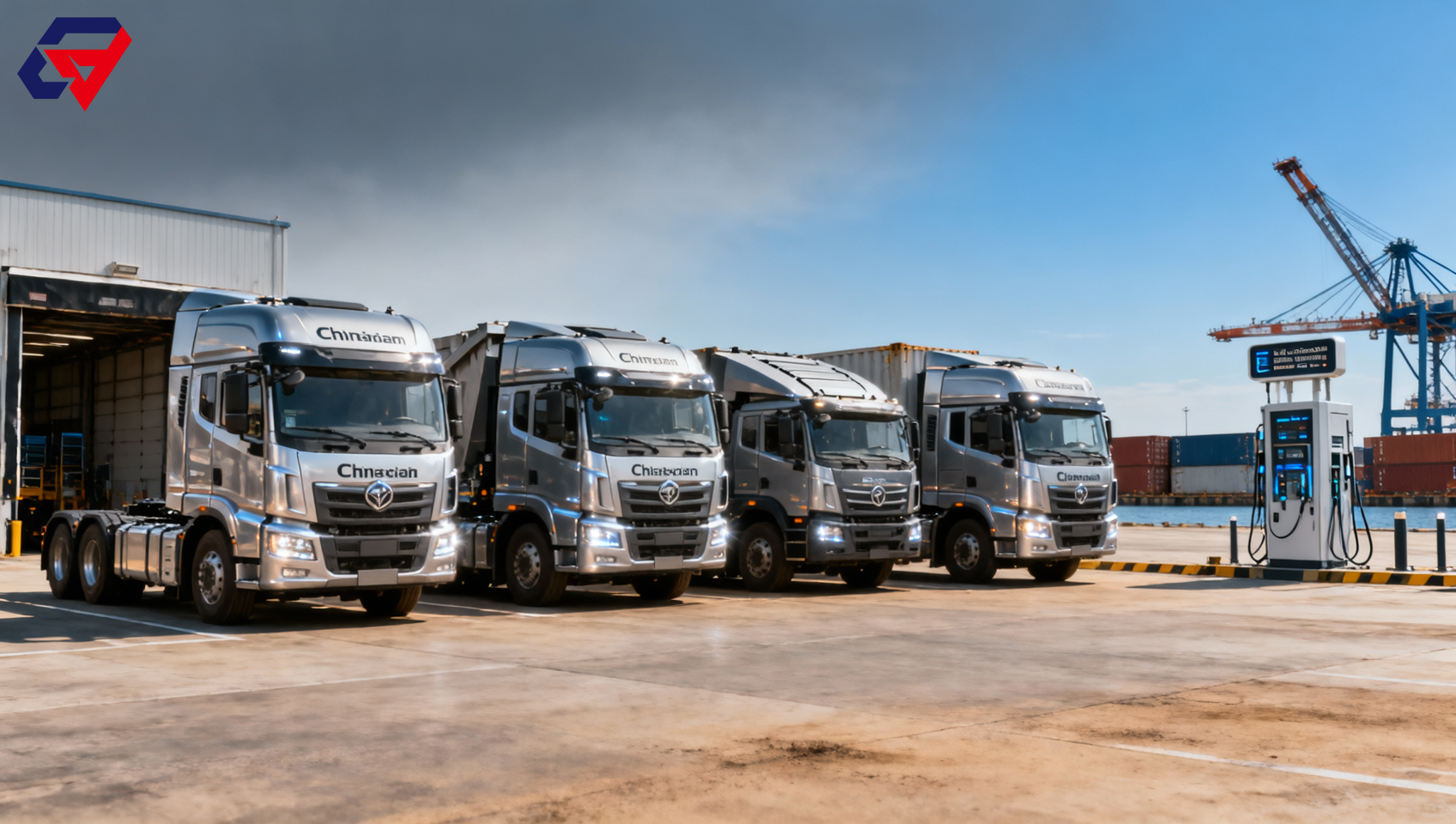
In Q1 2026, Chinese new-energy heavy truck manufacturers—including Weidu Technology, DeepWay (Shenxiang), and Subao Technology—secured concentrated large-scale orders from buyers in the United States, European Union, and Middle East. The deals span multiple operational scenarios: long-haul freight, mining transport, and port tractor applications. This development signals growing international recognition of Chinese electric heavy-duty trucks—notably regarding total cost of ownership (TCO), megawatt-level charging compatibility, and emerging local service network capabilities—and warrants close attention from stakeholders in global commercial vehicle trade, certification services, logistics infrastructure, and after-sales support sectors.
Event Overview
In Q1 2026 (January–March 2026), Weidu Technology, DeepWay (Shenxiang), and Subao Technology publicly confirmed the execution of major export orders for battery-electric heavy trucks targeting markets in the United States, European Union, and Gulf Cooperation Council (GCC) countries. Deliveries cover use cases including cross-border freight corridors, open-pit mining operations, and container handling at seaports. No further details on order volumes, contract values, or delivery timelines have been disclosed beyond this scope.
Industries Affected by Segment
Direct Export Trading Firms
These firms face increased demand for regulatory coordination and shipment scheduling due to the scale and geographic dispersion of the orders. Impact manifests primarily in heightened lead-time sensitivity, customs classification complexity (e.g., EV chassis vs. complete vehicles), and documentation requirements tied to regional safety and emissions certifications.
Certification & Compliance Service Providers
Providers supporting ECE R100 (EU electric vehicle safety), GCC Type Approval, and U.S. FMVSS/SAE alignment are seeing intensified inquiry volume. The impact centers on workload volatility and tighter turnaround expectations—particularly where clients seek concurrent certification across multiple jurisdictions.
After-Sales Support & Service Network Operators
Operators managing spare parts logistics, technician training, and remote diagnostics infrastructure must now assess scalability beyond pilot deployments. Impact is visible in accelerated planning cycles for regional warehousing, bilingual technical documentation, and third-party service partner onboarding—especially in GCC and EU Tier-2 logistics hubs.
Charging Infrastructure Integrators
Integrators engaged in depot-level megawatt charging system deployment (e.g., 3.75 MW+ liquid-cooled systems) are encountering earlier-stage collaboration requests from fleet buyers. The impact lies in revised pre-deployment validation protocols—particularly around interoperability with Chinese OEM-specific communication stacks and battery management interfaces.
Key Points for Enterprises and Practitioners to Monitor and Act Upon
Track official certification progress—not just announcements
Public order confirmations do not equate to completed type approvals. Enterprises should monitor national transport authority portals (e.g., EU’s JRC database, UAE’s ESMA portal) for verified ECE R100 or GCC certification status, rather than relying solely on press releases.
Map delivery timing against local infrastructure readiness
Orders targeting ports or mines require synchronized commissioning of on-site charging and maintenance facilities. Importers and fleet operators should verify whether supplier-provided delivery schedules assume existing site-readiness—or include phased infrastructure enablement clauses.
Distinguish between pilot deployments and scalable rollouts
Early orders may involve customized configurations or limited production batches. Procurement teams should review contractual terms on scalability triggers (e.g., minimum order thresholds for localized assembly or parts sourcing) before committing to multi-year fleet transition plans.
Assess service network commitments beyond sales materials
Review contractual SLAs on spare parts lead time, technician response windows, and software update frequency—not just marketing claims about ‘local presence’. Prioritize suppliers with auditable service center footprints in target countries, not just regional offices.
Editorial Perspective / Industry Observation
From industry perspective, this wave of Q1 2026 orders is best understood as a structural signal—not yet a fully matured market outcome. It reflects growing buyer confidence in TCO models and charging interoperability under real-world conditions, but does not yet indicate broad-based substitution of legacy diesel platforms across regulated transport segments. Analysis来看, the pace of certification completion and first-year field reliability data will be more decisive than order volume alone in determining whether this trend sustains beyond 2026. Observation来看, the emphasis on mining and port use cases suggests early adoption is being driven by controlled environments with high fuel-cost exposure and fixed-route predictability—rather than open-road long-haul, where range anxiety and charging access remain higher barriers.
Conclusion
This development marks a measurable inflection point in global commercial EV supply chain dynamics—but remains an early-stage, scenario-dependent expansion. It is more accurately interpreted as evidence of selective international buyer validation under specific operational constraints, rather than a wholesale shift in heavy-duty transport procurement norms. Current interpretation should emphasize verification of certification status, infrastructure alignment, and service scalability—rather than extrapolating broad market penetration.
Information Sources
Main source: Publicly announced order confirmations issued by Weidu Technology, DeepWay (Shenxiang), and Subao Technology in Q1 2026. No third-party verification or independent audit reports have been published to date. Ongoing observation is required for ECE R100 certification status, GCC Type Approval issuance, and first deliveries under these contracts.
NAVIGATION
Send Us A Message