



News
Explore what’s going on around the industry and get the latest from the world of heavy equipment and earth-moving.
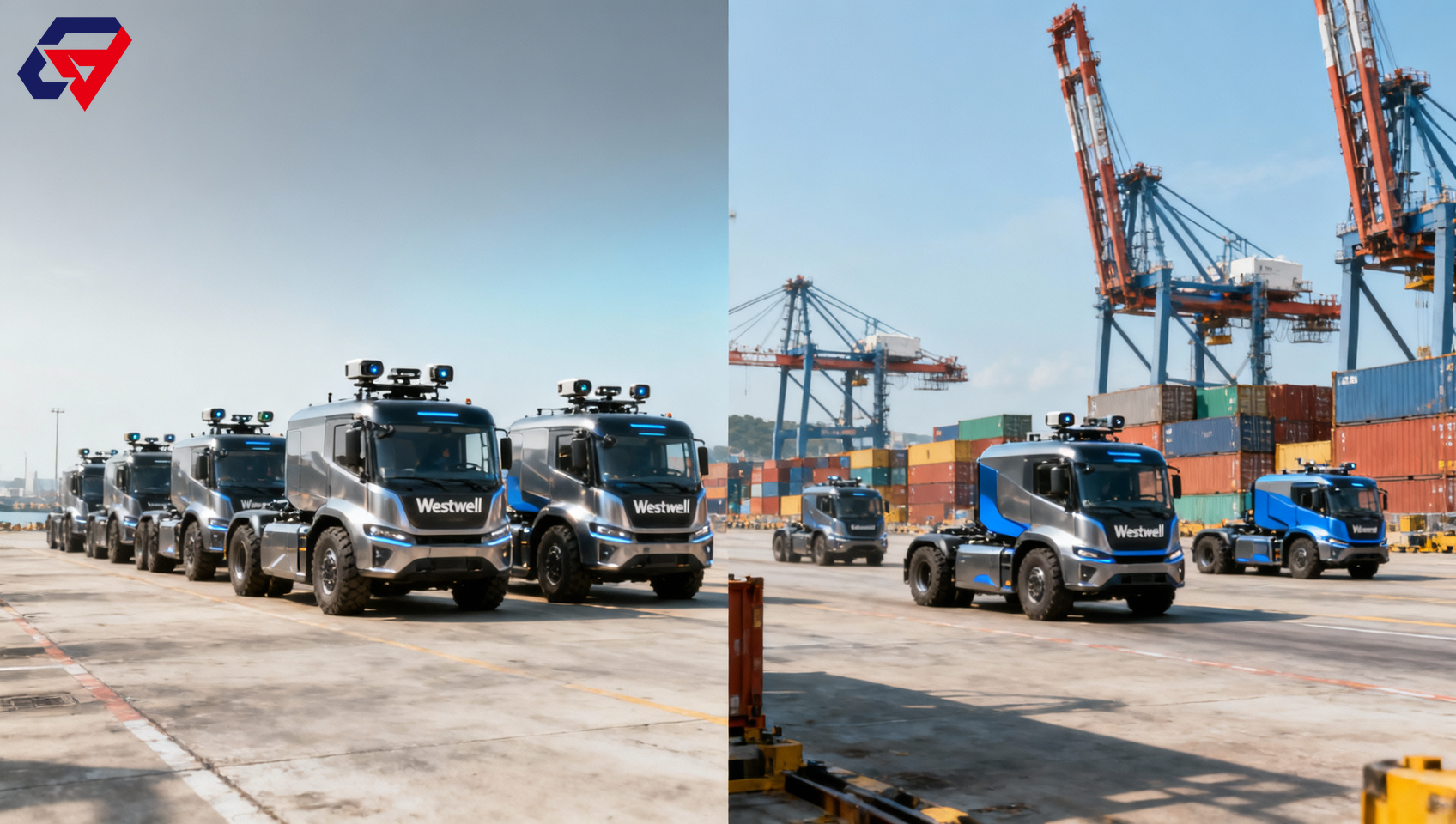
On April 21, 2026, Kwai Tsing Container Terminal in Hong Kong commenced commercial operations of six driverless heavy-duty trucks (ATs) developed by China’s Westwell Technology — the first verified deployment of a Chinese autonomous truck system in an internationally benchmarked port environment. This milestone is especially relevant for global port operators, freight forwarders, cross-border logistics service providers, and import/export enterprises assessing technical maturity, operational adaptability, and regulatory alignment of China-developed autonomous freight solutions.
Event Overview
On April 21, 2026, six autonomous heavy-duty trucks (ATs) without driver cabins — designed and supplied by Westwell Technology — entered active service at Kwai Tsing Container Terminal in Hong Kong. The vehicles operate using AI algorithms, centimeter-level positioning, and mixed-traffic orchestration capabilities, enabling 24/7 container handling operations. This marks the first commercially operational validation of a Chinese autonomous heavy-truck system within a high-compliance international port setting.
Impact on Specific Industry Segments
International Port Operators
Port operators outside mainland China may now treat this deployment as a real-world reference point for evaluating feasibility, safety governance models, and infrastructure integration requirements of autonomous heavy-vehicle systems. The mixed-operation mode — where autonomous trucks coexist with conventional equipment and human-driven vehicles — provides empirical insight into traffic coordination logic, latency tolerance, and fail-safe protocols under live port conditions.
Freight Forwarders & Third-Party Logistics (3PL) Providers
Forwarders serving Asia-Pacific trade lanes may face evolving service expectations around terminal dwell time, predictability of gate-in/gate-out windows, and digital handover traceability. As autonomous systems generate structured operational data (e.g., precise arrival/departure timestamps, container-handling cycle times), forwarders may need to adapt internal performance tracking and SLA reporting frameworks accordingly.
Importers & Export-Oriented Trading Companies
For companies managing just-in-time inventory across regional supply chains, improved terminal throughput consistency — potentially enabled by 24/7 autonomous operations — could reduce buffer stock requirements or enable tighter shipment scheduling. However, any near-term impact remains contingent on scalability beyond the initial six-unit pilot and integration depth with existing terminal operating systems (TOS).
Supply Chain Technology Integrators
Integrators supporting port digitalization projects may observe increased demand for interoperability layers between autonomous vehicle fleets and legacy TOS, yard management systems (YMS), and customs declaration platforms. The Hong Kong deployment highlights the practical importance of standardized API design, cybersecurity certification alignment, and real-time data synchronization — not just vehicle autonomy itself.
What Relevant Enterprises or Practitioners Should Monitor and Do Now
Track official updates on regulatory scope and expansion plans
Monitor announcements from the Hong Kong Marine Department and Transport Department regarding whether this pilot will be extended to additional terminals, or whether new technical or operational conditions (e.g., weather restrictions, shift coverage rules) will be formalized — as these signal readiness for broader adoption.
Assess compatibility with current terminal interface standards
Logistics service providers and technology vendors should review whether their existing systems support ISO 8217, EDI 940/944, or other data exchange protocols used in the Kwai Tsing deployment — particularly those related to vehicle dispatch instructions, container status updates, and exception reporting.
Distinguish between policy endorsement and operational readiness
While the deployment reflects technical validation, it does not imply immediate regulatory harmonization across jurisdictions. Enterprises evaluating similar solutions elsewhere should separate local government support signals from actual fleet integration capability — especially concerning cybersecurity accreditation, insurance frameworks, and cross-border liability assignment.
Prepare for potential shifts in service-level agreement (SLA) benchmarks
Freight service buyers should begin documenting current baseline metrics (e.g., average gate-to-gate time, peak-hour congestion duration) at key ports — to later assess whether autonomous deployments meaningfully alter performance thresholds or introduce new reliability dependencies (e.g., software update cycles, remote monitoring uptime).
Editorial Perspective / Industry Observation
From an industry perspective, this event is best understood not as a fully scaled commercial breakthrough, but as a critical pathfinder validation: it confirms that a Chinese-developed autonomous heavy-truck system can meet the functional, safety, and interoperability expectations of a Tier-1 international port — under live, non-simulated conditions. Analysis来看, the significance lies less in immediate volume impact (6 units represent a minimal share of total terminal movements), and more in its role as a reference case for compliance pathways and operational integration logic. Observation来看, stakeholders should treat this as an early-stage signal — one that invites scrutiny of implementation details (e.g., how human supervisors intervene, how edge cases are logged and resolved), rather than as evidence of imminent widespread replacement of conventional terminal tractors.
This development does not yet indicate market readiness for global procurement, nor does it resolve jurisdiction-specific regulatory fragmentation. Instead, it establishes a verifiable anchor point against which future technical upgrades, policy proposals, and competitive offerings can be comparatively assessed.
Conclusion
The deployment of Westwell’s autonomous heavy-duty trucks at Kwai Tsing Terminal represents a concrete step in the functional validation of Chinese-origin autonomous freight technology within demanding international infrastructure environments. It offers tangible evidence for stakeholders evaluating technical viability — but not yet a template for rapid replication. Currently, it is more appropriately understood as a benchmarking milestone: useful for informed due diligence, not for strategic procurement decisions without further context on scalability, regulatory portability, and long-term operational sustainability.
Source Attribution
Main source: Official announcement by Kwai Tsing Container Terminal and Westwell Technology, dated April 21, 2026.
Areas requiring ongoing observation: Expansion timeline beyond the initial six units; integration depth with Hong Kong’s broader port digital infrastructure; formal recognition by international port associations or classification societies.
NAVIGATION
Send Us A Message