


News
Explore what’s going on around the industry and get the latest from the world of heavy equipment and earth-moving.
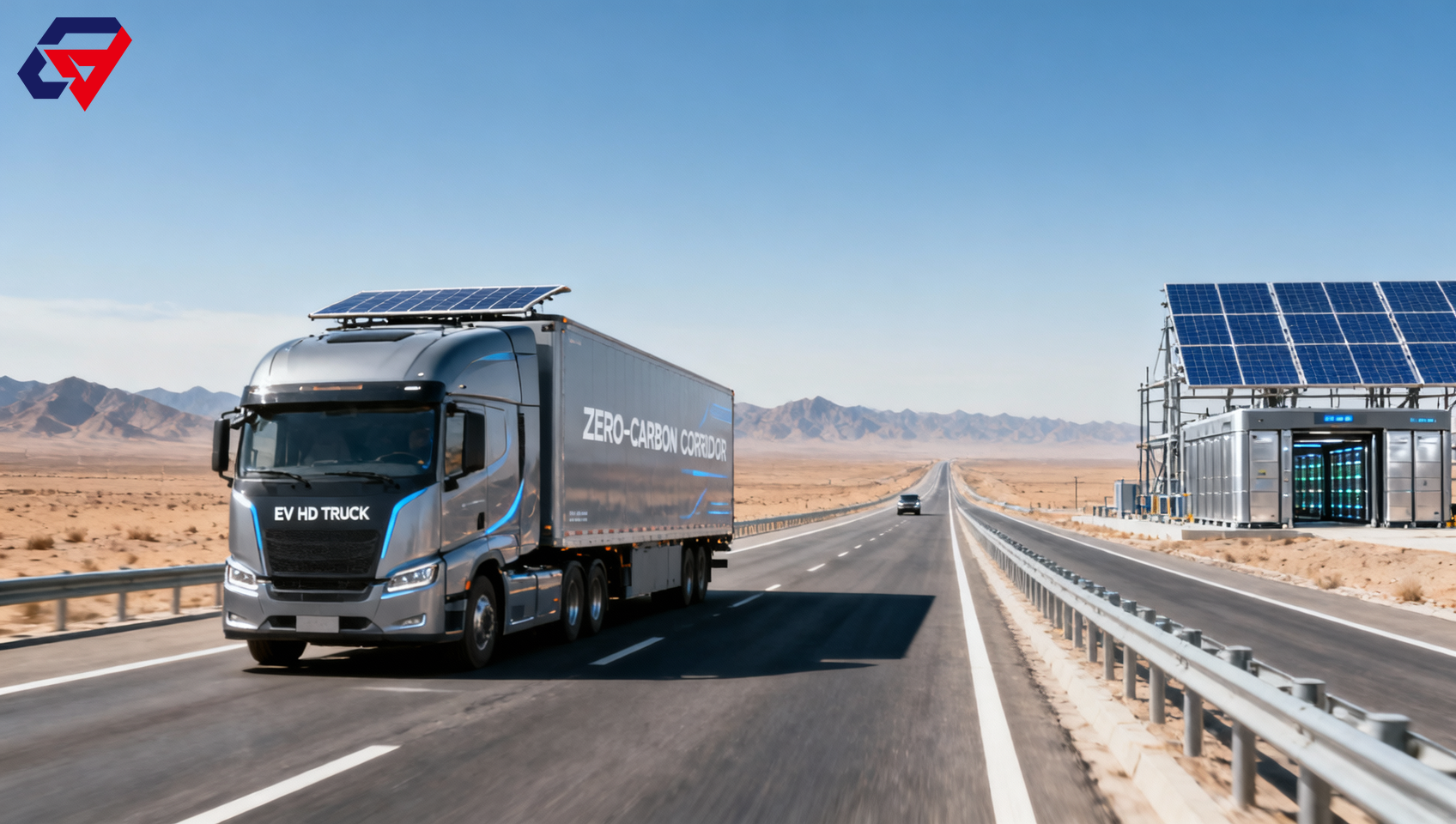
China’s G30 Lianhuo Expressway Shaanxi section has been officially approved as a zero-carbon corridor on May 22, 2026 — marking the first provincial-scale highway infrastructure initiative in Western China explicitly designed to enable electric heavy-duty truck logistics across borders. The approval signals a strategic shift toward decarbonizing long-haul freight corridors linking Northwest China with Central Asia and Russia, where energy infrastructure reliability has historically constrained adoption of battery-electric commercial vehicles.
Event Overview
The ‘zero-carbon corridor’ plan for the G30 Lianhuo Expressway’s Shaanxi segment was approved on May 22, 2026. It calls for construction of 10 integrated photovoltaic–energy storage–charging–battery-swapping stations along the Xi’an–Urumqi trunk route, exclusively serving electric heavy-duty trucks. These stations will be open to cross-border logistics operators engaged in China–Central Asia freight transport.

Industries Affected
Direct Trading Enterprises
Export-oriented trading firms supplying electric heavy-duty trucks to Kazakhstan, Uzbekistan, and other Central Asian markets are directly impacted. Prior to this approval, importers faced uncertainty over post-purchase operational viability — particularly regarding charging availability, downtime risk, and total cost of ownership. With fixed, renewable-powered refueling infrastructure now confirmed along a primary transit axis, buyers gain contractual certainty on fleet deployment timelines and service-level agreements. This may accelerate purchase decisions, especially for state-backed or logistics consortium buyers.
Raw Material Procurement Enterprises
Suppliers of lithium, cobalt, graphite, and PV-grade polysilicon — particularly those with downstream exposure to battery and solar module manufacturers serving transportation infrastructure projects — face revised demand signals. While not an immediate procurement surge, the corridor’s scale (10 stations, each requiring multi-MW solar arrays, MWh-scale storage, and high-power DC chargers/swapping modules) implies sustained mid-term orders for energy components. However, procurement enterprises should note that tendering and equipment selection phases remain pending; current impact is anticipatory rather than transactional.
Manufacturing Enterprises
OEMs producing electric heavy-duty trucks — especially those with modular battery systems compatible with standardized swapping protocols — stand to benefit from improved real-world validation environments. The corridor offers a controlled, high-utilization testbed for thermal management, battery longevity, and interoperability under arid, high-temperature conditions typical of the Hexi Corridor and Tarim Basin. Yet manufacturing firms must avoid overinterpreting the approval as near-term volume assurance: station commissioning timelines, grid interconnection approvals, and vehicle certification for cross-border operation remain separate regulatory tracks.
Supply Chain Service Providers
Firms offering EV fleet telematics, battery health analytics, cold-chain-compatible swapping logistics, and cross-border customs facilitation platforms may see early engagement opportunities. The corridor’s design emphasizes interoperability and data connectivity — prerequisites for coordinated charging/swapping scheduling across time zones and jurisdictions. Still, service providers should recognize that commercial contracts will depend on station operators’ (not just planners’) technology stack choices, which have yet to be disclosed.
Key Considerations and Recommended Actions
Monitor station operator selection and technical specifications
The State Grid Shaanxi branch and local development authorities are expected to issue tenders for EPC and O&M contracts within Q3 2026. Technical specs — especially battery interface standards (e.g., GB/T vs. CATL’s Shenxing protocol), voltage levels (750V vs. 1000V+), and data-sharing requirements — will determine compatibility windows for equipment vendors and software providers.
Assess cross-border vehicle certification pathways
While infrastructure is being built in China, electric heavy-duty trucks operating into Kazakhstan or Russia require type approval under respective national frameworks. Stakeholders should initiate parallel engagement with Eurasian Economic Commission (EAEU) technical committees and national auto regulators — particularly on electromagnetic compatibility (EMC), braking performance under loaded desert conditions, and onboard diagnostics compliance.
Evaluate localized energy pricing and subsidy mechanisms
The project integrates photovoltaic generation but remains connected to the regional grid. Commercial users will rely on dynamic tariff structures, including possible time-of-use incentives and green certificate monetization. Enterprises planning fleet operations should model energy cost sensitivity across seasonal irradiance variations and grid congestion patterns before finalizing TCO projections.
Editorial Perspective / Industry Observation
Observably, this approval is less about immediate capacity addition and more about signaling institutional commitment to resolve the ‘infrastructure paradox’: investors hesitate to deploy electric trucks without charging infrastructure, while infrastructure developers hesitate without proven truck deployment volumes. By anchoring investment in a high-visibility national artery — and tying it explicitly to export competitiveness — policymakers have reframed the corridor as a trade-enabling asset, not merely a climate initiative. Analysis shows that similar ‘anchor corridor’ strategies in Norway (E6) and California (I-5) preceded 18–24 month inflection points in regional EV freight adoption. Yet unlike those cases, China’s implementation faces added complexity: multi-jurisdictional harmonization, sparse population density, and limited existing EV maintenance ecosystems across the route. This makes phased rollout fidelity — not just headline approval — the critical variable.
Conclusion
The G30 Lianhuo Expressway Shaanxi zero-carbon corridor approval represents a structural milestone: it institutionalizes electric heavy-duty transport as part of China’s outward-looking logistics architecture. Its true significance lies not in the number of stations, but in how it reshapes risk allocation across the value chain — shifting infrastructure uncertainty from private operators to public–private delivery mechanisms. A rational observation is that its success will be measured not by kilowatt-hours delivered, but by the number of cross-border electric truck purchase orders finalized within 12 months of first station commissioning.
Source Attribution
Official approval notice issued by the Shaanxi Provincial Development and Reform Commission (SPDRC) and the Shaanxi Provincial Department of Transport, May 22, 2026. Project documentation remains non-public pending EIA finalization and land-use permits. Key elements under continued observation include: (1) final site selection and environmental impact assessment outcomes; (2) procurement timeline and bidder eligibility criteria for station construction; (3) intergovernmental MOUs with Kazakhstan and Uzbekistan on mutual recognition of EV safety and data standards.
NAVIGATION
Send Us A Message