



News
Explore what’s going on around the industry and get the latest from the world of heavy equipment and earth-moving.

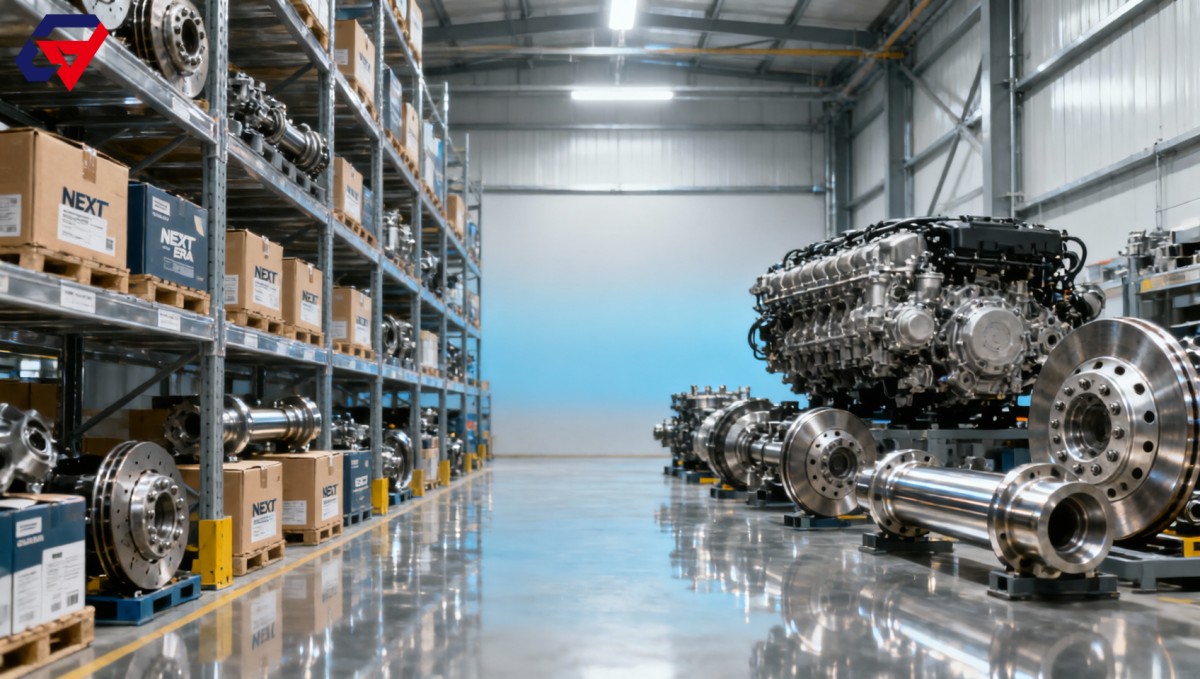
NEXT ERA Heavy-Duty Trucks officially launched its independent China Parts Center on April 22, 2026 — a development with implications for international commercial vehicle distributors, after-sales service providers, and cross-border supply chain operators serving emerging markets.
Event Overview
Effective April 22, 2026, NEXT ERA Heavy-Duty Trucks began operating a dedicated China-based spare parts center. All parts distributed through this hub undergo Scania’s global quality validation process and are integrated in real time with NEXT ERA’s nationwide service network. This initiative departs from the industry norm of deploying parts infrastructure only after vehicle delivery, enabling full lifecycle parts support at the point of vehicle handover to overseas customers.
Industries Affected
Direct Export Trading Firms
These firms — especially those distributing heavy-duty trucks into the Middle East, Latin America, and Africa — face structural challenges in managing spare parts logistics and warranty fulfillment. With NEXT ERA’s China Parts Center now active, their ability to guarantee timely part availability improves, directly reducing customer downtime risk and strengthening contractual service commitments.
After-Sales Service Providers & Distributors
Local service networks in regions with underdeveloped aftermarket infrastructure previously relied on long lead times or air-freighted emergency shipments. The new hub enables more predictable replenishment cycles and tighter alignment between inventory planning and field service demand — particularly for high-rotation wear items and critical driveline components.
Supply Chain & Logistics Service Providers
Third-party logistics (3PL) and freight forwarders handling heavy-truck parts shipments from China may see increased volume in standardized, quality-validated SKUs destined for regional distribution hubs. Coordination requirements with NEXT ERA’s real-time scheduling system — rather than batch-based order releases — could shift operational workflows toward higher visibility and shorter planning horizons.
What Relevant Enterprises Should Monitor and Do Now
Track official updates on hub coverage scope and regional dispatch protocols
The current announcement confirms launch timing and quality validation standards but does not specify which part categories, vehicle platforms, or destination markets are prioritized in Phase 1. Exporters and service partners should monitor NEXT ERA’s official communications for rollout sequencing — especially regarding minimum order thresholds, lead time guarantees, and documentation requirements for customs clearance.
Assess impact on TCO modeling for specific export markets
Analysis shows that reduced parts lead times and lower emergency logistics costs can meaningfully lower total cost of ownership (TCO) calculations — particularly in markets where local warehousing is prohibitively expensive or unreliable. Firms should re-run TCO models using updated parts availability assumptions, focusing on failure-prone subsystems (e.g., braking, cooling, and transmission components).
Align internal service SOPs with real-time inventory synchronization expectations
Observably, the hub’s integration with NEXT ERA’s national service network implies data-sharing readiness. Distributors and service centers should verify compatibility of their warehouse management systems (WMS) or service information systems (SIS) with NEXT ERA’s API or EDI protocols — especially if planning to leverage just-in-time replenishment features.
Editorial Perspective / Industry Observation
This initiative is better understood as an operational signal — not yet a fully scaled outcome. While the April 22, 2026 launch date is confirmed, the extent of geographic coverage, inventory depth per SKU, and average fill rate across target markets remain unconfirmed. From an industry perspective, it reflects a broader strategic pivot: shifting from vehicle-centric export models toward integrated, lifecycle-support-led market entry. For stakeholders, sustained attention is warranted — not because the hub is transformative today, but because its design signals a growing expectation among Chinese OEMs that parts reliability must be demonstrable at contract signing, not deferred to post-sale execution.
Conclusion
The launch of NEXT ERA’s China Parts Center marks a procedural refinement in how premium heavy-duty truck exporters manage after-sales risk in infrastructure-constrained markets. It does not eliminate logistical complexity, but it introduces a more controllable variable: parts delivery predictability. Currently, this development is best interpreted as a capability milestone — one that raises the baseline expectation for service readiness among buyers in emerging markets, and invites recalibration of competitive positioning by channel partners.
Source Attribution
Main source: Official NEXT ERA Heavy-Duty Trucks announcement (date unspecified, referencing April 22, 2026 activation).
Points requiring ongoing observation: Regional rollout sequence, SKU-level inventory coverage, and verified on-the-ground lead time performance across target markets (Middle East, Latin America, Africa).
NAVIGATION
Send Us A Message