



News
Explore what’s going on around the industry and get the latest from the world of heavy equipment and earth-moving.

On June 24, 2026, the launch of a dedicated China-Europe freight service from Xi’an for new-energy heavy truck logistics signaled more than a transport milestone: it highlighted a more execution-oriented trade and compliance pathway for cross-border delivery of high-value new-energy equipment. For exporters, component suppliers, procurement teams, customs-facing logistics providers, and technical compliance functions, the notable point is the combination of a customs green channel, a stated clearance window of under 48 hours, and support for carbon-footprint pre-verification and destination-market technical adaptation pre-inspection.
What the launch confirms at this stage
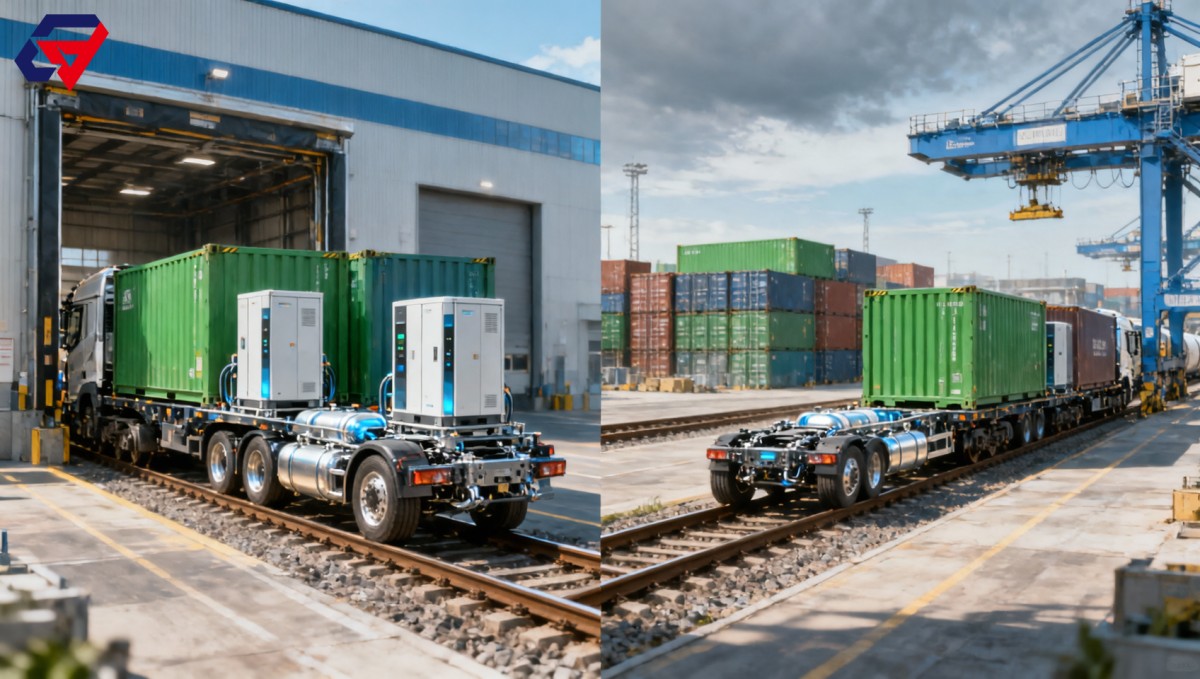
According to the provided event summary, the first dedicated logistics train for new-energy heavy trucks under the Chang’an service departed from Xi’an International Port Station on June 24, 2026, bound for the Duisburg hub in Germany. The cargo included Foton BEACON liquid-hydrogen heavy truck chassis, standardized battery-swap station modules from Qiyuan Xindongli, and Yunchi air-suspension systems, described as high-value components.
The same summary states that the train used a customs “green channel” for new-energy equipment, reducing overall customs clearance time to within 48 hours. It also states that the service supports full-container carbon-footprint pre-verification and pre-inspection for technical adaptation to the destination country.
Why this matters across the delivery chain
For exporters of complete systems and key components
Analysis shows that the most immediate implication is not only faster transport organization, but earlier compliance preparation. Where shipments include liquid-hydrogen truck chassis, swap-station modules, and suspension systems, exporters may need to align product files, shipment documents, and technical descriptions more tightly before departure if they want to benefit from pre-verification and pre-inspection arrangements. What deserves closer attention is whether internal export documentation is ready at the same speed as customs facilitation.
For procurement and project delivery teams
From an industry perspective, a dedicated service with a shorter stated clearance cycle can affect planning assumptions for project-based delivery, especially when orders combine vehicle platforms and infrastructure modules. Procurement teams may need to watch whether supplier qualification files, technical specifications, and traceability records are sufficiently complete at the order-confirmation stage, rather than being assembled close to shipment.
For logistics and customs service providers
Observably, the green-channel arrangement raises the operational value of service providers that can coordinate customs filing, cargo classification, technical document matching, and pre-shipment communication in one process. The impact is likely to be felt in handover timing, document accuracy, and exception management, particularly for cargo categories that may require more careful technical description during cross-border movement.
For compliance, testing, and certification-related functions
Analysis shows that carbon-footprint pre-verification and destination-market technical adaptation pre-inspection could shift part of the compliance workload forward in the delivery chain. Even though the provided information does not define the detailed execution standard, companies involved in testing, certification support, or technical review should pay attention to whether customers begin requesting earlier submission of product declarations, technical files, and supporting test materials.
Practical points companies should watch now
Document readiness may become a delivery variable
Companies shipping through similar channels should closely monitor whether commercial documents, technical descriptions, and product-related supporting materials can be synchronized earlier in the export process. The event suggests a stronger connection between customs efficiency and documentation completeness, even though no detailed operating rule has yet been provided in the input.
Carbon-related disclosures deserve closer review
What deserves closer attention is the mention of full-container carbon-footprint pre-verification. At this stage, it is more appropriate to treat this as an execution signal rather than a fully defined rule set in the provided material. Still, exporters and suppliers may need to review whether their existing product and shipment records can support carbon-related information requests without delaying dispatch.
Technical adaptation checks may move earlier
The reference to destination-country technical adaptation pre-inspection suggests that some technical compatibility questions may be addressed before arrival rather than after shipment. Companies should therefore watch for changes in customer-facing technical checklists, bid documentation, acceptance conditions, and after-sales preparation, especially where equipment is intended for a specific overseas operating environment.
Lead-time assumptions should remain cautious
Although the summary mentions clearance within 48 hours, companies should avoid treating that figure as a universal outcome across all future shipments. Observably, firms should continue to build delivery plans around controllable factors such as document quality, supplier coordination, and pre-shipment review readiness, while watching whether the execution scope of the service becomes clearer over time.
How this signal should be read
Analysis shows that this development is best understood as a practical execution signal in cross-border handling of new-energy transport equipment, rather than as a stand-alone transport update. The combination of a dedicated train, green-channel customs treatment, carbon-footprint pre-verification, and destination-market technical pre-inspection points to a delivery model in which trade movement and compliance preparation are becoming more closely linked.
At the same time, it is too early to read the event as a complete or settled rule framework based on the provided information alone. From an industry perspective, the more important question is how consistently such arrangements are implemented in later shipments, and whether market participants begin to adjust procurement files, supplier requirements, and contract delivery terms accordingly.
A measured takeaway for the market
The industry significance of this event lies in its indication that export logistics for new-energy heavy truck systems and related modules may increasingly depend on front-loaded customs and technical preparation. It is more appropriate to understand this development as an operational sign of rule execution and process tightening, not yet as proof of a fully standardized market practice. Companies connected to export delivery, procurement, compliance review, and technical service should therefore track follow-up execution details with caution rather than assume that all procedures or timelines have already stabilized.
Basis of this article and what still needs verification
This article is generated from the user-provided news title, event date, and event summary. For events of this type, relevant source categories usually include official announcements, customs or trade-administration releases, regulator communications, industry association updates, standard-setting documents, and reporting by established trade media.
No specific official source link was provided in the input, so the exact official basis still needs to be verified on an ongoing basis. Observably, the areas that remain worth tracking include detailed implementation rules, certification and technical review practice, wording used in procurement or tender documents, market feedback from participating companies, and how consistently similar arrangements are applied in subsequent shipments.
NAVIGATION
Send Us A Message