



News
Explore what’s going on around the industry and get the latest from the world of heavy equipment and earth-moving.

On July 21, 2026, the latest operating notices from Maersk and COSCO Shipping signaled a direct logistics shift for heavy truck exports from China to the Middle East. From the third week of July 2026, sailings carrying complete heavy trucks and KD kit container shipments from Qingdao, Shanghai, and Tianjin to markets including Saudi Arabia, the UAE, and Egypt have been rerouted around the Cape of Good Hope. For exporters, assembly-linked buyers, and supply chain service providers, the key issue is not only a longer transit window, but also the immediate effect on delivery planning, freight cost visibility, and schedule reliability.
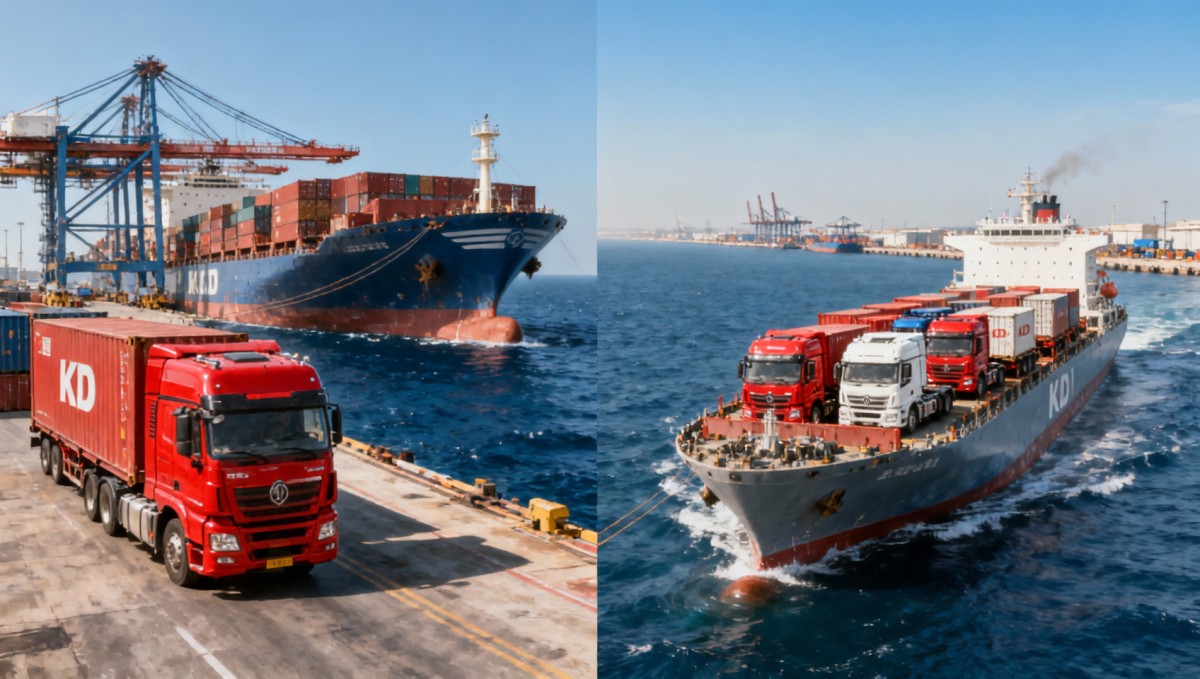
What the latest carrier notices confirm
According to the operating notices cited, the rerouting was triggered by an escalation in the security situation in the Red Sea area. As a result, the affected China-to-Middle East heavy truck and KD shipment services are no longer using the previous route and are instead sailing via the Cape of Good Hope.
The revised routing adds about 6,200 nautical miles to a one-way voyage. The average delivery cycle has therefore extended from 32 days to 50 days. In parallel, some carriers have raised the BAF on Asia-Africa routes by 12% and have suspended on-schedule commitments for new bookings made before July 25.
Where the pressure is likely to show first
Exporters shipping complete heavy trucks face a longer delivery window
From an industry perspective, companies exporting fully built heavy trucks are likely to feel the impact first in dispatch planning and customer delivery coordination. When average lead time extends by 18 days, the pressure shifts to shipment timing, contract execution, and the ability to keep destination-side delivery expectations aligned with actual vessel movement.
KD cargo flows may face tighter assembly sequencing risks
For businesses moving KD kits, the issue is not simply a slower ocean leg. Analysis shows that longer transit time can affect the rhythm between shipment release and downstream assembly preparation. What deserves closer attention is whether the new routing changes the timing assumptions that buyers and suppliers had been using for parts arrival and production scheduling.
Freight service providers must manage both cost and promise risk
For logistics companies, forwarders, and related service providers, the confirmed BAF increase and the suspension of on-schedule commitments create a more difficult operating environment. The challenge is likely to appear in quotation validity, booking communication, and service-level expectations, especially where customers still expect earlier transit assumptions to hold.
Buyers in Middle East markets need closer shipment visibility
Import-side buyers in Saudi Arabia, the UAE, and Egypt are also exposed to the operational change. Observably, the practical impact is likely to center on receiving schedules, inventory timing, and installation or deployment plans linked to truck arrivals or KD cargo intake. The longer route makes shipment visibility more important than before.
What companies should track now
Watch for further carrier wording and rule adjustments
Businesses involved in these lanes should monitor whether carriers update routing language, surcharge mechanisms, or booking terms beyond the notices already mentioned. The current facts confirm rerouting, a BAF increase by some carriers, and a pause in on-schedule commitments for certain new bookings, so any change in official wording could affect how contracts and customer notices are handled.
Recheck delivery commitments already tied to July cargo plans
For shipments linked to July dispatch cycles, a practical focus is whether existing delivery dates, customer milestones, or internal handover plans were built on the earlier 32-day transit assumption. Analysis shows that the issue is especially relevant where sales, shipping, and receiving teams are working from different lead-time baselines.
Review booking, documentation, and customer communication discipline
Where schedule commitments are no longer being maintained for new bookings before July 25, companies should pay closer attention to booking confirmation language, shipment documentation timing, and customer-facing updates. This is less about broad management theory and more about avoiding mismatched expectations once cargo is already in motion.
Separate surcharge impact from transit-time impact
What deserves closer attention is the difference between two distinct pressures: higher transport cost from the BAF adjustment and slower cargo movement from the route change. Treating them as a single issue can weaken internal decision-making, especially when pricing teams, supply chain teams, and commercial teams need to respond on different timelines.
Why this should be read as more than a routine delay notice
Analysis shows that this development is more meaningful than an isolated vessel delay because it combines three confirmed changes at once: a route shift, a longer transit cycle, and altered carrier service commitments. At the same time, it is not yet appropriate to frame it as a fully settled long-term structural reset based only on the information provided here. It is more appropriate to understand this as an active operational disruption with immediate commercial consequences and with further developments still needing verification.
From an industry perspective, the news matters because heavy truck exports and KD movements are highly dependent on timing discipline. Once average delivery moves from 32 to 50 days, the operational impact can extend beyond shipping into order coordination and destination-side planning. That is why this item deserves continued attention even without adding assumptions that have not been confirmed.
How to interpret the current signal
At this stage, the most balanced reading is that the market is facing a confirmed short-term operating change with the potential to influence wider trade execution if it persists. The facts already indicate longer transit, additional route distance, some surcharge pressure, and weaker schedule assurance for certain bookings. The prudent conclusion is not to overstate the outcome, but to recognize that this is a material logistics signal for China-to-Middle East heavy truck trade and related KD cargo flows.
Basis of this article and what still needs checking
This article is based on the user-provided news title, event date, and event summary. The factual basis cited in the input refers to the latest operating notices from Maersk and COSCO Shipping. For this type of development, commonly relevant source categories may include official carrier notices, company announcements, industry association updates, authoritative media reporting, and other formal shipping-related documents.
A specific official source link was not provided in the input, so continued verification is still necessary. Follow-up attention should remain on any updated carrier notices, changes to surcharge language, and whether service commitments or routing arrangements are revised again after the period referenced in the current information.
NAVIGATION
Send Us A Message