



News
Explore what’s going on around the industry and get the latest from the world of heavy equipment and earth-moving.
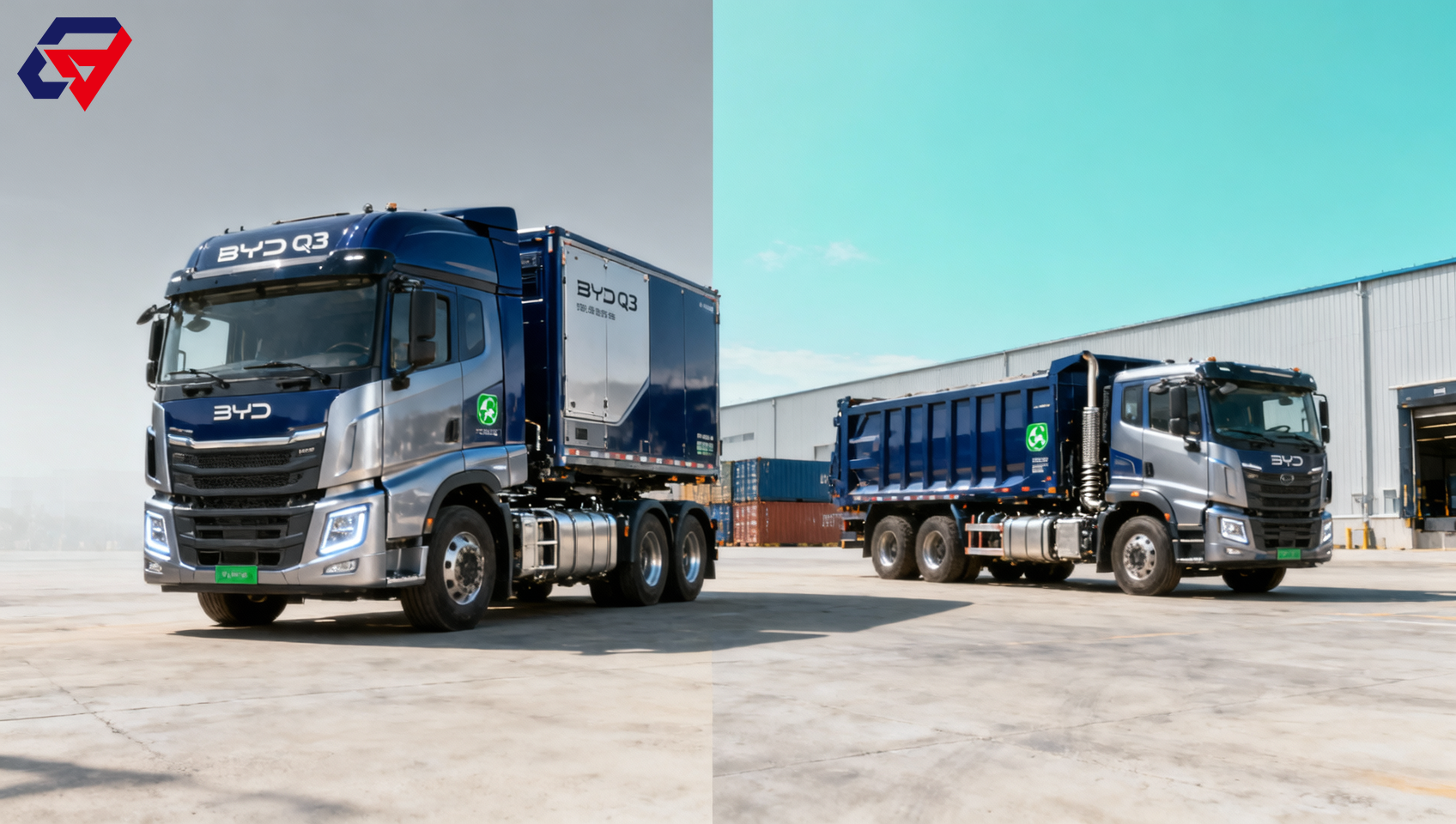
On April 24, 2026, BYD Commercial Vehicles finalized a strategic order for 150 units of Q3 battery-electric tractors and T31 battery-electric dump trucks with Hunan Logistics Group — while simultaneously announcing signed knock-down (KD) assembly agreements with partners in Thailand and Indonesia. This development signals a structural shift in China’s NEV heavy-truck export model and warrants close attention from international trade, automotive distribution, and logistics infrastructure stakeholders.
Event Overview
On April 24, 2026, BYD Commercial Vehicles completed a contract in Changsha for 150 units of the Q3 pure electric tractor and T31 pure electric dump truck with Hunan Logistics Group. The agreement includes localized maintenance training and a pre-positioned spare parts warehouse. On the same day, BYD announced signed KD assembly agreements with partners in Thailand and Indonesia; the first shipment of CKD kits is scheduled to depart in June 2026.
Industries Affected
Direct Export Trading Firms
These firms face a functional shift: from managing FOB/CIF整车 shipments to coordinating CKD kit logistics, local certification support, and technical transfer oversight. The move reduces reliance on full-container-load ocean freight but increases complexity in customs classification, tariff treatment, and cross-border technical documentation.
Supply Chain Service Providers (Logistics, Warehousing, Customs Brokerage)
Providers must now accommodate mixed-mode cargo flows — including high-value powertrain modules, low-volume precision components, and non-standardized packaging for assembly lines. Pre-positioned spare parts warehouses (as stipulated in the Hunan deal) also imply demand for bonded or near-factory warehousing with real-time inventory tracking capability.
Local Automotive Assembly & Aftermarket Operators (Thailand, Indonesia)
Partners entering KD arrangements will require expanded capabilities in high-voltage system integration, battery handling compliance, and certified technician training. Their capacity to scale service networks — especially for battery diagnostics and regenerative braking system maintenance — will directly affect product uptime and customer retention.
Domestic Component Suppliers (China-based)
Suppliers aligned with BYD’s Q3/T31 platforms may see increased demand for export-ready sub-assemblies (e.g., axle carriers, cab frames, thermal management modules). However, localization pressure could accelerate requests for regional sourcing — meaning suppliers must assess whether their current quality certifications (e.g., ISO/TS 16949 equivalent) meet ASEAN regulatory thresholds.
What Enterprises and Practitioners Should Monitor and Act On
Track official KD implementation timelines and regulatory alignment
Monitor announcements from Thai and Indonesian industrial ministries regarding EV assembly incentives, local content requirements, and homologation pathways — as these will determine viable production ramp-up speed and cost structure.
Assess readiness for technical knowledge transfer and service network scaling
Channel partners and distributors should audit internal training curricula and diagnostic tool compatibility with BYD’s latest VMS protocols — particularly for battery state-of-health estimation and over-the-air update support.
Distinguish between policy intent and operational execution
The June 2026 CKD shipment target reflects a milestone, not guaranteed volume. Stakeholders should treat it as a signal of supply chain readiness — not as confirmed quarterly export volume — and verify actual kit composition, BOM completeness, and local labor skill mapping before committing capital.
Prepare for hybrid spare parts logistics models
With pre-positioned spare parts warehouses now part of standard commercial terms (as in the Hunan deal), importers and 3PLs should evaluate dual-channel inventory strategies: fast-moving consumables (brake pads, fuses) held regionally, while high-cost, low-turnover items (motor inverters, battery modules) managed via just-in-sequence delivery from China or regional hubs.
Editorial Perspective / Industry Observation
Observably, this event marks less a discrete transaction and more a procedural inflection point: Chinese NEV heavy-truck exports are evolving beyond unit sales into integrated capability deployment. Analysis shows the emphasis on localized training, spare parts warehousing, and KD partnerships reflects a deliberate effort to de-risk long-term channel viability — especially in markets where after-sales responsiveness directly influences fleet utilization rates. From an industry standpoint, it is better understood not as a new market entry, but as a test case for replicable, service-integrated export architecture. Sustained observation is warranted — particularly on whether subsequent deals replicate the same tripartite structure (vehicle + training + parts + local assembly) across other ASEAN or LATAM markets.
This development underscores a broader recalibration in global commercial vehicle electrification: value capture is shifting from hardware margins toward embedded service infrastructure and technical sovereignty. For stakeholders, it is more accurate to interpret this as an early-stage operational blueprint — one that prioritizes channel durability over short-term shipment volume.
Information Source: Official announcement by BYD Commercial Vehicles, dated April 24, 2026. Note: KD production timelines, regulatory approvals in Thailand and Indonesia, and final CKD kit specifications remain subject to ongoing verification.
NAVIGATION
Send Us A Message