



News
Explore what’s going on around the industry and get the latest from the world of heavy equipment and earth-moving.
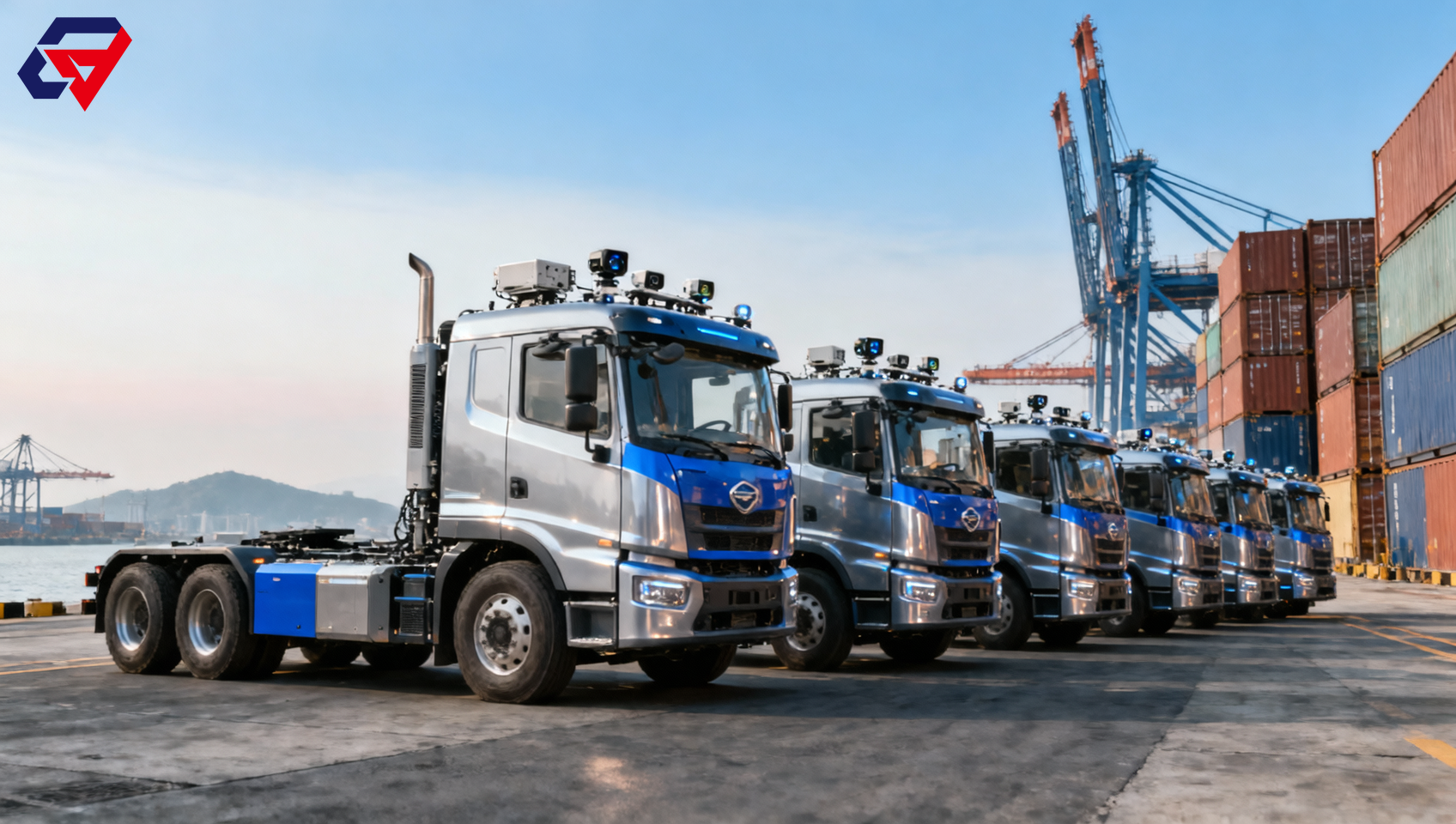
On April 21, 2026, Hong Kong’s Kwai Tsing Container Terminal deployed six driverless heavy-duty trucks (AT) developed by China’s Westwell Technology — the first such autonomous vehicles officially operational in Hong Kong. This development is particularly relevant for cross-border logistics providers, freight forwarders serving RCEP and Southeast Asian markets, and importers assessing compliance and localization capabilities of Chinese intelligent transport equipment.
Event Overview
On April 21, 2026, six autonomous heavy-duty trucks (AT) without driver cabins — developed by Westwell Technology — entered formal operation at Hong Kong’s Kwai Tsing Container Terminal. The vehicles employ AI algorithms, centimeter-level positioning, and co-location mixed-operation capability, enabling 24/7 container handling. No further technical specifications, regulatory approvals, or expansion timelines have been publicly confirmed.
Industries Affected by Segment
Direct Trading Enterprises
These enterprises rely on timely, predictable handovers across the Hong Kong–Mainland China border. The deployment shortens cross-border trunk connection cycles — a key bottleneck in just-in-time delivery to Southeast Asia and RCEP markets. Impact manifests as reduced dwell time at terminals and tighter alignment between ocean vessel arrivals and inland truck departures.
Freight Forwarding & Third-Party Logistics Providers
Firms managing multimodal cargo flows through Hong Kong face direct implications for yard coordination and scheduling efficiency. With 24-hour autonomous operations, stacking, retrieval, and gate-out sequencing can be decoupled from human shift constraints — potentially compressing turnaround windows and improving slot utilization in congested terminals.
Importers Evaluating Chinese Intelligent Equipment
Overseas buyers assessing export-ready autonomous systems — especially those subject to automotive functional safety standards — now have a live case study in Hong Kong. The deployment offers observable evidence on UN R155 and ISO 26262 adaptation progress, as well as real-world performance under port-specific operational and regulatory conditions.
What Relevant Companies or Practitioners Should Monitor and Do Now
Track official updates on regulatory recognition status
Monitor announcements from Hong Kong’s Transport Department and the Office of the Government Chief Information Officer regarding formal classification of these AT units — e.g., whether they are treated as “automated guided vehicles” or “autonomous motor vehicles” under current road and port ordinances. Classification affects insurance, liability frameworks, and scalability beyond terminal boundaries.
Assess impact on specific cross-border lane dependencies
Review current reliance on Shenzhen Bay, Lok Ma Chau, or Huanggang checkpoints for container transfers. Early-stage deployments like this one are typically confined to controlled terminal environments; any future extension to public roads would signal broader infrastructure readiness — but that remains unconfirmed and outside current scope.
Distinguish between operational validation and commercial rollout
This is a pilot-scale deployment (6 units), not a full fleet transition. Stakeholders should treat it as an operational benchmark — not an immediate trigger for contract renegotiation or process overhaul. Focus instead on how yard-handling KPIs (e.g., average container dwell time, gate-to-yard cycle) evolve over the next 3–6 months.
Prepare internal alignment on equipment compliance documentation
For procurement teams evaluating similar autonomous systems, begin compiling internal checklists aligned with UN R155 certification pathways and local type-approval expectations — using this deployment as a reference point for required test reports, cybersecurity documentation, and maintenance protocol disclosures.
Editorial Perspective / Industry Observation
Observably, this deployment functions primarily as a regulatory and operational proof point — not yet a scalable service model. It validates integration within a tightly managed terminal environment, but does not indicate imminent adoption across public highways or multi-terminal networks. Analysis shows that its primary value lies in de-risking localized implementation: demonstrating interoperability with existing terminal operating systems (TOS), safety protocols, and workforce coordination models. From an industry perspective, this is less about near-term capacity uplift and more about building institutional confidence in certified, context-aware automation — a prerequisite for wider regional adoption.
Concluding, this milestone reflects incremental, infrastructure-anchored progress — not a disruptive shift. It signals growing maturity in deploying autonomous commercial vehicles within defined operational zones, but remains bounded by jurisdictional scope, vehicle count, and use-case specificity. Current understanding should center on its role as a monitored reference case — not a template for immediate replication.
Information Source: Public announcement by Westwell Technology and Kwai Tsing Container Terminal, dated April 21, 2026. Note: UN R155/ISO 26262 compliance status, long-term expansion plans, and integration with mainland Chinese regulatory frameworks remain unconfirmed and require ongoing observation.
NAVIGATION
Send Us A Message